Copyright ©IFS 2024 | All Rights Reserved.

When it comes to maintaining comfortable and safe environments in large commercial buildings, hospitals, data centres, and industrial facilities, the question that always comes up is: What Is a Chiller HVAC system, and how does it work? A chiller HVAC system is one of the most powerful and efficient cooling technologies available today, designed to handle the massive thermal loads that standard split or packaged AC units simply cannot manage. At I-Focus Solutions, we specialise in deploying and managing advanced chiller plant systems that keep your facility running at peak efficiency.
So, what is a chiller HVAC system at its core? Simply put, it is a refrigeration-based system that removes heat from a liquid, typically water or a water-glycol mixture, and then circulates that chilled liquid through a building’s air handling units (AHUs) or fan coil units (FCUs) to cool the space. Unlike conventional air conditioners that cool air directly, chiller systems use water as a heat transfer medium, making them exceptionally efficient for large-scale applications.
There are two primary types of chillers: air-cooled and water-cooled. Air-cooled chillers dissipate heat through ambient air using condensers mounted outside the building, while water-cooled chillers use cooling towers and condenser water loops for more efficient heat rejection. Both types are integral to understanding what is a chiller HVAC system and which configuration best suits your facility’s needs.
To truly understand what is a chiller HVAC system, you need to understand its major components and how they work together as a unified ecosystem:
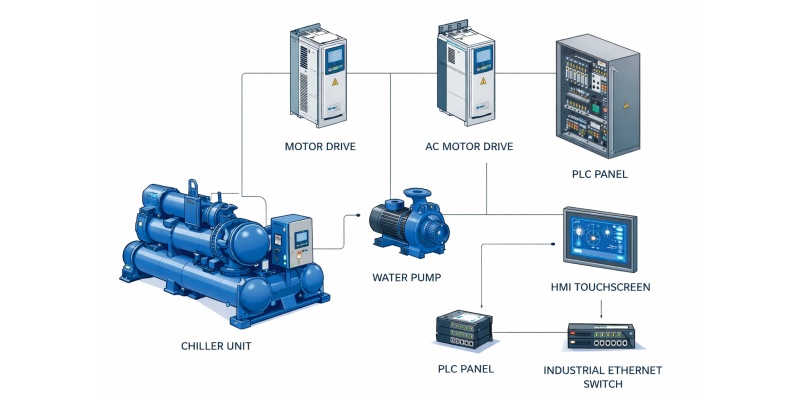
The chiller is the heart of the entire system. It uses a refrigerant cycle, compression, condensation, expansion, and evaporation, to extract heat from chilled water. Modern chillers are highly efficient machines with intelligent controls built in, capable of modulating their output based on the facility’s real-time cooling demand.
The water pump is responsible for circulating chilled water throughout the building’s piping network. In large facilities, multiple pumps, both primary and secondary, are deployed to ensure consistent flow and pressure across all zones. Variable-speed water pumps, when combined with intelligent controllers, dramatically reduce energy consumption during partial-load conditions.
The motor drive, commonly referred to as a Variable Frequency Drive (VFD), is a critical component in modern chiller HVAC plants. It controls the speed of electric motors powering compressors, fans, and pumps by varying the frequency of the electrical supply. By matching motor speed to actual load demand rather than running motors at fixed full speed, the motor drive can reduce energy consumption by 30–50%, making it one of the most impactful upgrades in any HVAC optimization project.
An AC Motor Drive is specifically engineered for industrial HVAC environments. It regulates the speed of AC induction motors used in cooling towers, chiller compressors, and air handling units. When integrated within a chiller plant management system, AC motor drives work in tandem with PLCs and HMIs to optimize performance dynamically, extending equipment lifespan while minimizing wear and operational costs.
The PLC is the intelligent brain behind chiller plant automation. It continuously monitors sensor data, including temperatures, pressures, flow rates, and power consumption, and executes pre-programmed logic to optimize chiller sequencing, pump staging, and load balancing. A well-programmed PLC eliminates human error, ensures rapid fault response, and enables predictive maintenance by flagging anomalies before they become costly failures.
The HMI provides operators with a real-time graphical interface to monitor and control the entire chiller plant. Through intuitive touchscreen dashboards, facility managers can view live system data, adjust setpoints, acknowledge alarms, and generate performance reports, all from a centralized location. The HMI bridges the gap between complex automation logic and practical day-to-day operations, making it indispensable for large commercial facilities.
Modern chiller plants rely on seamless data communication between controllers, drives, sensors, and management systems. The Industrial Ethernet Switch forms the backbone of this communication infrastructure, providing reliable, high-speed, noise-resistant networking in demanding industrial environments. It connects PLCs, HMIs, AC motor drives, and remote monitoring platforms into a unified, integrated system, enabling real-time data exchange that is essential for smart building management.
Understanding what is a chiller HVAC system is only half the picture. The bigger question is why it is indispensable for large-scale commercial and industrial operations:
Chiller systems can be scaled from hundreds to thousands of tons of cooling capacity, making them the go-to solution for hospitals, airports, malls, data centers, and high-rise commercial buildings.
With components like AC motor drives, variable-speed water pumps, and intelligent PLCs working in concert, a well-managed chiller plant consumes significantly less energy than conventional cooling systems of comparable capacity.
Through HMI and SCADA integration, facility managers get complete visibility and control over the entire chiller plant from a single platform, reducing staffing requirements and response times.
Multiple chillers and pumps can be staged and rotated, ensuring uninterrupted cooling even during maintenance or equipment faults, a non-negotiable requirement for mission-critical facilities.
While the initial investment in a chiller plant is higher than conventional cooling, the long-term savings in energy, maintenance, and downtime more than justify the cost.
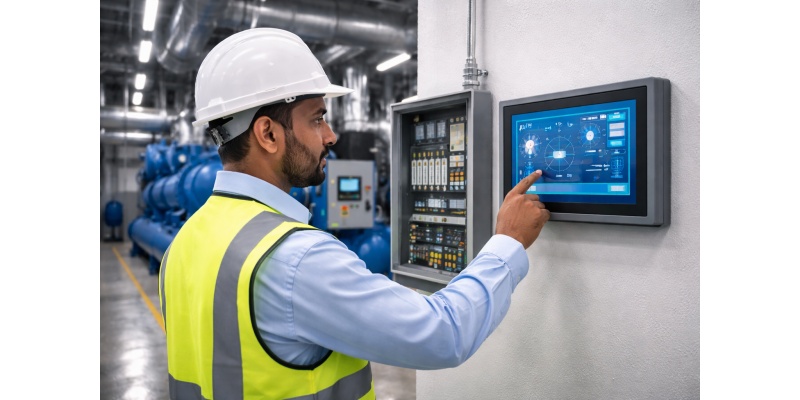
In today’s era of smart buildings and Industry 4.0, the question of what is a chiller HVAC system has evolved beyond simple refrigeration. Modern chiller plants are fully integrated automation ecosystems. PLCs process thousands of data points per second, Industrial Ethernet Switches ensure millisecond-level communication between devices, AC motor drives dynamically adjust equipment speeds, and HMIs give operators live command and control. This convergence of hardware and software intelligence transforms a chiller plant from a passive cooling utility into an active energy management asset.
I-Focus Solutions deploys advanced chiller plant automation solutions that integrate all these components into a cohesive, high-performance system. Our platforms provide predictive analytics, remote diagnostics, energy benchmarking, and automated fault response, ensuring your chiller plant operates at peak performance around the clock.
As a leading provider of HVAC services in Bangalore, I-Focus Solutions brings deep technical expertise and a proven track record in designing, commissioning, and managing chiller plants for commercial and industrial facilities across the region. From initial system design to PLC programming, HMI development, motor drive configuration, and ongoing maintenance, our team delivers end-to-end solutions tailored to your facility’s specific requirements.
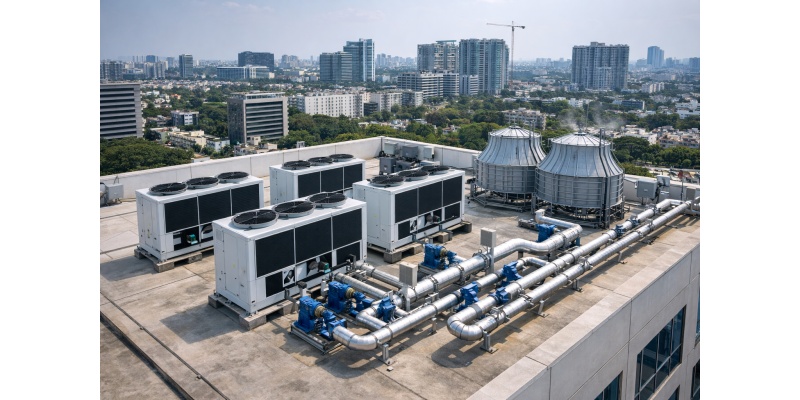
Even the most sophisticated chiller HVAC system requires regular monitoring, calibration, and maintenance to sustain its efficiency. Fouling in heat exchangers, refrigerant leaks, pump seal degradation, and drive parameter drift are all common issues that, when left unchecked, can reduce system efficiency by 15–25% or more. Proactive chiller plant management, powered by real-time data from PLCs, HMIs, and Industrial Ethernet networks, is the key to preventing these losses and extending the operational life of every component in the system.
At I-Focus Solutions, our Chiller Plant Manager platform continuously tracks key performance indicators (KPIs) such as Coefficient of Performance (COP), chiller efficiency (kW/ton), and pump differential pressure. Automated alerts notify your team the moment a parameter drifts outside optimal thresholds, enabling immediate corrective action before minor inefficiencies become major failures.
Understanding what is a chiller HVAC system is the first step toward making informed decisions about your facility’s long-term cooling strategy. From the chiller and water pump at the physical layer, to the motor drive and AC motor drive at the control layer, to the PLC and HMI at the automation layer, and the Industrial Ethernet Switch at the communications layer — every component plays a vital role in delivering reliable, efficient, and intelligent cooling.
For large commercial facilities where uptime, efficiency, and occupant comfort are non-negotiable, a professionally managed chiller plant is not a luxury, it is an absolute operational necessity. I-Focus Solutions is your trusted partner in maximizing the performance and longevity of your chiller HVAC investment.