Copyright ©IFS 2024 | All Rights Reserved.

Fire safety is not a one-time installation; it is a continuous commitment. For facility managers, safety officers, and building heads, keeping fire extinguishers compliant and operational is one of the most critical responsibilities on the job. A missed inspection or an expired cylinder is not merely a compliance failure; it can cost lives. This guide gives you a thorough, actionable fire extinguisher checklist designed specifically for annual maintenance and safety compliance reviews.
Most facility heads understand that fire extinguishers must be present on the premises. Far fewer appreciate the depth of ongoing maintenance required to ensure those extinguishers will actually work when seconds count. According to the National Building Code of India and guidelines issued by the Chief Fire Officer’s office, fire suppression equipment must be inspected, tested, and serviced at defined intervals. Failure to comply can result in penalties, voided insurance claims, and, most critically, preventable casualties.
A well-maintained fire extinguisher checklist is the backbone of any fire safety programme. It converts vague intent into documented, auditable action, creating a paper trail that protects your facility, your occupants, and your organization from liability. Whether you manage a commercial tower, a manufacturing unit, a hospital, or an IT park, the discipline of the checklist is universal.
Monthly checks are quick but essential. Designate a trained safety marshal or facility staff member for this task. Your monthly fire extinguisher checklist must cover the following:
Location and Accessibility: Confirm each extinguisher is in its designated spot, clearly visible, and not obstructed by equipment, furniture, or stored goods.
Pressure Gauge Reading: The pressure needle must rest in the green zone. A reading in the red zone, whether too high or too low, requires immediate attention.
Safety Pin and Tamper Seal: The pull-pin must be intact, and the tamper seal (plastic tie or breakable ring) must be unbroken. A broken seal indicates the unit may have been discharged or tampered with.
Physical Condition: Look for dents, rust, corrosion, leakage, or damage to the hose and nozzle. Any visible damage is a red flag that warrants removal from service.
Label Legibility: Operating instructions must be fully visible and readable. Faded or peeling labels require immediate replacement.
Inspection Tag: Verify that the most recent inspection date is logged on the tag attached to the unit.
Each completed monthly check must be recorded in a facility register or a digital safety management system. Documentation is not optional — it is what separates a genuinely safety-conscious facility from one that is merely hoping for the best.
Annual inspections go far beyond a visual scan. They require trained technicians, specialized tools, and coordination with certified service providers. This is where your fire extinguisher checklist becomes most comprehensive — and most consequential from a statutory compliance standpoint.
Full Internal and External Inspection: Qualified technicians disassemble the unit, inspect all internal components, check for corrosion or agent caking, and reassemble the extinguisher correctly to manufacturer standards.
Agent Level Verification: Confirm that the extinguishing agent, dry powder, CO₂, foam, or water, is at the correct fill level as specified by the manufacturer.
Cylinder Pressure Testing (Hydrostatic Test): Required every three to five years, depending on the extinguisher type. This test confirms the cylinder can safely withstand its rated pressure without risk of failure.
Valve and Mechanism Functionality: Test the operation of the valve, discharge mechanism, and locking assembly for smooth, reliable function. Any stiff or compromised component must be replaced.
Hose and Nozzle Condition: Inspect for cracks, clogging, hardening, or blockage. Deteriorated components must be replaced before the unit is returned to service.
Service Tagging and Record Update: The attending technician affixes a new service tag showing the date, service provider name, and next due date. All records must be updated in the facility’s compliance register simultaneously.
Placement Review: Reassess extinguisher placement against the current floor plan. Renovations or layout changes may have created zones that are no longer adequately covered.
As per IS 2190, the Indian Standard for Selection, Installation, and Maintenance of First-Aid Fire Extinguishers, all portable fire extinguishers must undergo a thorough annual examination by a competent person. Non-compliance can result in a failed fire safety audit and the loss of your facility’s Fire NOC or Occupancy Certificate.
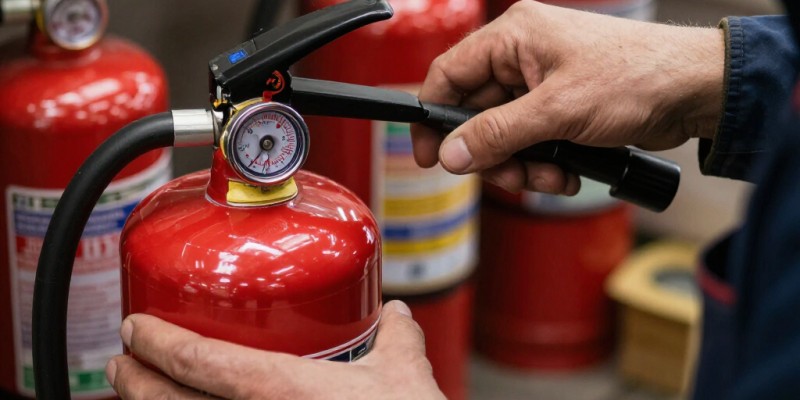
Every extinguisher that has been discharged — even partially — must be recharged immediately. Do not wait for the next scheduled service cycle. Beyond discharge, there are mandatory refill intervals that are legally required regardless of use.
Partnering with professional fire extinguisher refilling services ensures that the correct agent type and fill volume are used, all seals are replaced to manufacturer standards, and refilled units pass pressure tests before being returned to service. Attempting refills in-house without certified equipment is both dangerous and non-compliant.
Here is a general reference for refill and testing intervals by extinguisher type:
| Extinguisher Type | Refill Interval | Hydrostatic Test |
| ABC Dry Powder | Every 1 year | Every 3 years |
| CO₂ (Carbon Dioxide) | Every 1 year or on weight drop | Every 5 years |
| Foam (AFFF) | Every 1 year | Every 5 years |
| Water-Based | Every 1 year | Every 5 years |
| Clean Agent | As per the manufacturer’s specification | Every 5 years |
Even a perfectly maintained extinguisher is a compliance risk if its service history is not properly recorded. Your fire extinguisher checklist programme must include structured record-keeping that can be produced on demand during audits by the fire department, insurance inspectors, or statutory authorities.
Each unit should have a dedicated log containing its serial number and type, installation date and location, all inspection dates and outcomes, refilling history with agent type and quantity, hydrostatic test certificates, and the name and certification details of each servicing technician. Facilities using digital facility management platforms can automate alerts for upcoming service due dates, reducing the risk of any unit falling out of compliance unnoticed.
A fire extinguisher is only as effective as the person operating it. No compliance programme is complete without a parallel effort to train occupants and safety wardens. Annual training must cover the PASS technique (Pull, Aim, Squeeze, Sweep), correct extinguisher selection for different fire classes, evacuation protocols and the circumstances in which firefighting should not be attempted, and the exact location of every unit across the facility. All training sessions must be documented, and new employees should receive fire safety orientation as part of their induction.

For facility heads in Karnataka, working with experienced fire protection companies in Bangalore makes the entire compliance journey far more manageable. The right partner handles scheduled inspections on time, manages refilling logistics, deploys certified technicians, and generates all documentation required for regulatory compliance — typically under a structured Annual Maintenance Contract.
Look for providers certified under relevant IS standards, with demonstrated experience across commercial and industrial environments, in-house service infrastructure rather than sole reliance on subcontractors, and the ability to provide digital compliance reports.
I Focus Solutions, headquartered in Bangalore, brings over 12 years of hands-on expertise in fire safety, electronic security, and building management systems. Their AMC programmes cover everything from fire extinguisher refilling services to comprehensive fire alarm systems, making them a trusted partner for hotels, IT parks, warehouses, and commercial properties across the city. Visit ifsind.com to learn more or schedule a consultation.
Use this consolidated fire extinguisher checklist during your facility’s annual safety review:

The most dangerous assumption in fire safety is that because nothing has gone wrong yet, nothing will. A robust fire extinguisher checklist maintained monthly, executed thoroughly on an annual basis, and supported by trained staff transforms fire safety from a reactive concern into a proactive culture.
Facility heads who treat fire safety as a year-round operational priority, rather than a box to tick before an audit, create genuinely safer environments for everyone inside their buildings. They also protect their organizations from serious legal and financial exposure.
Start with a structured checklist, partner with a reliable AMC provider, and build the documentation discipline that compliance demands. The investment is minimal. The return measured in lives protected and liabilities avoided is immeasurable.