
Fire safety is not an afterthought. It is a legal obligation and a moral responsibility for every commercial building owner and facility manager. Whether you manage an IT park in Bengaluru, a warehouse in Pune, or a hospitality complex in Mumbai, understanding the types of fire extinguisher in India is the foundation of a robust fire protection strategy.
This guide breaks down every major category, helps you match the right extinguisher to your specific risks, and explains what facility managers need to know to stay compliant with Indian standards.
Why the Right Fire Extinguisher Matters
Not all fires are the same. Using the wrong extinguisher can make a fire worse, cause explosions, or expose personnel to serious danger. The Bureau of Indian Standards (BIS) classifies fires into five categories (A, B, C, D, and K/F), and Indian fire safety regulations mandate that commercial establishments carry extinguishers appropriate for the hazards present on their premises.
Knowing the types of fire extinguisher in India is not just about compliance. It is about protecting your people, your assets, and your operations.
A Complete Classification of Fire Extinguishers
1. Water-Based Fire Extinguishers (Class A)
Water extinguishers are widely used for Class A fires involving ordinary combustibles like wood, paper, cloth, and cardboard. These are commonly found in offices, libraries, schools, and retail spaces.
Best suited for:
Paper-heavy offices, warehouses storing dry goods, and educational institutions.
Not suitable for:
Electrical equipment, flammable liquids, or kitchen fires involving cooking oil.
Water mist variants using de-ionised water are gaining popularity in Indian commercial setups as they offer improved safety around electrical areas compared to traditional water jets.
2. CO2 (Carbon Dioxide) Fire Extinguishers (Class B and Electrical)
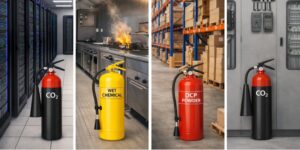
CO2 extinguishers are arguably the most important type for modern commercial environments in India. They work by displacing oxygen and leave no residue behind, making them ideal for server rooms, data centres, control panels, and areas with sensitive electronic equipment.
CO2 extinguishers are the go-to choice for IT infrastructure, electrical switchgear rooms, and laboratories in any commercial facility.
Best suited for:
Server rooms, electrical panels, and offices with large amounts of electronic equipment.
Not suitable for:
Deep-seated Class A fires or kitchen fires.
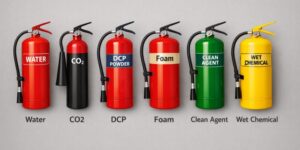
3. Dry Chemical Powder (DCP) Fire Extinguishers (Class A, B and C)
DCP extinguishers are the most versatile of all types of fire extinguisher in India and are widely deployed across industrial, commercial, and residential settings. They work by chemically interrupting the combustion reaction and can tackle Class A, B, and C fires, covering ordinary combustibles, flammable liquids, and flammable gases.
Best suited for:
Manufacturing plants, fuel storage areas, garages, automobile workshops, and LPG handling zones.
Important note:
DCP leaves a powdery residue that can damage sensitive electronics. For precision environments, opt for CO2 or clean agent alternatives.
4. Foam Fire Extinguishers (Class A and B)
Foam extinguishers are highly effective against liquid fires (Class B), particularly flammable liquids like petrol, diesel, and paint. The foam creates a blanket over the burning liquid, cutting off its oxygen supply. They are commonly found in petrol stations, paint shops, aircraft hangars, and chemical processing facilities.
Best suited for:
Fuel storage, petrochemical zones, and paint or solvent warehouses.
Not suitable for:
Electrical fires or Class D metal fires.
5. Clean Agent Fire Extinguishers (Halotron / FM-200)
Clean agent extinguishers use gaseous compounds such as FM-200 (HFC-227ea) or Halotron that suppress fires without leaving any residue and are safe around sensitive equipment. These represent a premium category among the types of fire extinguisher in India and are gaining rapid adoption in high-value commercial environments.
Best suited for:
Bank vaults, data centres, telecom rooms, museums, archives, and pharmaceutical storage.
Not suitable for:
Large open industrial areas or outdoor fires.
6. Wet Chemical Fire Extinguishers (Class K / Class F)
Wet chemical extinguishers are specifically engineered for kitchen fires involving cooking oils and fats. They work by creating a soapy foam layer over the burning oil, rapidly cooling the fire and preventing re-ignition through a process called saponification.
Given India’s booming food services and hospitality sector, wet chemical extinguishers are now a mandatory requirement in commercial kitchens across hotels, restaurants, canteens, and cloud kitchens.
Best suited for:
Commercial kitchens, catering units, hotel restaurants, and food processing plants.
Not suitable for:
Electrical fires, flammable liquid fires, or ordinary combustibles.
7. Sand Buckets and Specialised Class D Extinguishers
For facilities handling combustible metals such as magnesium, titanium, or sodium, specialised Class D extinguishers are essential. These are used in metal fabrication plants, research labs, and certain pharmaceutical manufacturing units. Sand buckets also remain relevant as a supplementary measure prescribed under certain factory regulations.
Matching Extinguisher Type to Your Building’s Risk Profile
Selecting the right extinguisher begins with understanding the dominant fire hazard in each zone of your building. General office spaces benefit from CO2 combined with water or DCP units. Server rooms and data centres should rely exclusively on CO2 or clean agent extinguishers to avoid residue damage. Warehouses and bulk storage call for DCP or foam. Commercial kitchens require wet chemical extinguishers without exception. Electrical panel rooms should be equipped with CO2 only. Fuel and chemical storage areas need both DCP and foam coverage. Metal workshops require Class D extinguishers.
As a facility manager, conduct a fire risk assessment annually and cross-reference your findings against the types of fire extinguisher in India mandated under IS 2190 (the Code of Practice for Selection, Installation and Maintenance of Portable Fire Extinguishers) and local fire department norms.
Compliance Standards: What Indian Regulations Require
Commercial buildings in India must comply with the National Building Code (NBC) 2016, which specifies extinguisher placement, signage, and type requirements based on occupancy category. IS 2190 is the core BIS standard every facility should use as a baseline reference. State fire department regulations may layer additional requirements based on building height or business activity. The Factory Act and Shops and Establishment Act provisions apply to industrial and retail facilities, particularly concerning the minimum number of extinguishers per floor area.
Regular inspection, maintenance, and certification of all extinguishers is non-negotiable. Most Indian states require annual fire safety NOC renewals, which include verification of extinguisher condition and full-premises coverage.
The Importance of Regular Maintenance and Refilling
Owning the right extinguishers is only half the job. Keeping them operational is the other. An uncharged or poorly maintained extinguisher is as dangerous as having none at all. This is where professional fire extinguisher refilling services become critical for facility managers.
Scheduled refilling, typically every 12 months or immediately after any discharge, ensures your extinguishers are fully charged, functional, and compliant. Professional refilling also includes inspection for cylinder corrosion, valve functionality, pressure gauge accuracy, and safety pin integrity. Always engage certified service providers trained under BIS standards and authorised by your local fire department.

Choosing a Trusted Fire Safety Partner in Bengaluru
For commercial buildings across South India, working with experienced fire protection companies in Bangalore ensures that your entire fire safety ecosystem, from extinguisher selection and placement to annual maintenance schedules and compliance documentation, is managed professionally and proactively.
I-Focus Solutions offers end-to-end fire safety solutions tailored for commercial establishments, including supply, installation, staff training, annual maintenance contracts, and full regulatory compliance support.
Conclusion
A well-protected commercial building starts with understanding the types of fire extinguisher in India and deploying them strategically across every risk zone. From CO2 units in your server rooms to wet chemical extinguishers in your commercial kitchens, every space has a specific fire hazard and a specific solution designed to address it.
Do not wait for an incident to audit your fire safety posture. Conduct a thorough assessment today, ensure your extinguishers are correctly specified and regularly serviced, and make certain your staff is trained to use them effectively.